
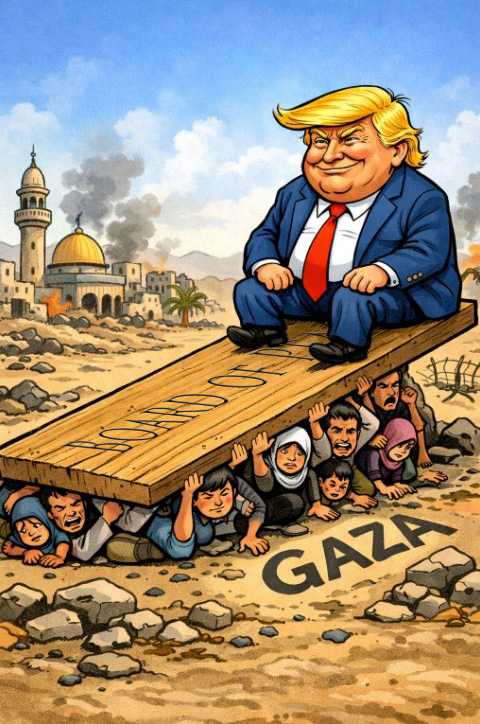
BIBLICAL WARNINGS ABOUT HUMAN-ENGINEERED PEACE .
Throughout Scripture, warnings appear about political attempts to manufacture peace through human institutions while ignoring deeper moral and spiritual realities. These passages are often cited by biblical commentators who caution that declarations of political peace do not necessarily produce genuine or lasting stability.
One of the most frequently referenced texts appears in First Epistle to the Thessalonians 5:3:
“For when they say, ‘Peace and safety,’ then sudden destruction comes upon them, as labor pains upon a pregnant woman, and they shall not escape.”
The apostle’s warning highlights the danger of premature or deceptive proclamations of peace. From a biblical perspective, peace declared without justice, repentance, or reconciliation can conceal deeper tensions that eventually erupt into crisis. For many interpreters, this verse serves as a reminder that political systems promising security may fail to address the underlying causes of conflict.
A second prophetic passage frequently discussed in connection with Middle Eastern diplomacy appears in Book of Daniel 9:27, which speaks of a future ruler who will “confirm a covenant with many for one week.” In prophetic interpretation, this passage is commonly understood as referring to a future multinational treaty connected specifically to Israel and the surrounding nations.
It is important to clarify that the proposed Board of Peace itself is not the covenant described in this prophecy. The agreement mentioned in Daniel 9:27 is widely interpreted by biblical scholars as a specific covenant involving Israel and a coalition of nations within an end-times prophetic framework.
Therefore, the Board of Peace—an international political initiative proposed by governments to oversee regional reconstruction and diplomacy—does not directly fulfill or correspond to the covenant referenced in Daniel. While contemporary events may occur within the broader flow of history leading toward the end times, the specific covenant described in the prophecy is understood to involve Israel directly within that prophetic framework.
Consequently, the prophecy in Daniel 9:27 is not directed toward the Palestinian people, nor does it function as a prediction concerning their political future. Within prophetic theology, the passage focuses primarily on Israel and the broader geopolitical alignment of nations surrounding Jerusalem.
This theme is reinforced by another prophetic text found in Book of Zechariah 12:3, which describes Jerusalem as a “burdensome stone for all nations.” The imagery suggests that international involvement in the governance and future of Jerusalem will repeatedly generate tension rather than produce permanent resolution. Historically and politically, the city has indeed become one of the most contested spaces in global diplomacy.
Taken together, these passages form a consistent biblical theme: human attempts to engineer lasting peace in Jerusalem and the surrounding region often prove fragile and temporary. Many Christian commentators therefore conclude that while political agreements may achieve short-term stability, Scripture ultimately points to a future and final peace that will come only through the reign of the Prince of Peace, a title given in Book of Isaiah 9:6.
Within biblical prophecy and eschatology, it is widely believed that when the Prince of Peace—Jesus Christ—returns to reign during the Millennium, genuine peace will finally be established on earth. This 1,000-year period, often referred to as the Millennial Kingdom, is described as a time of unprecedented peace, justice, and righteousness under divine rule.
Within this theological framework, modern initiatives such as the proposed Board of Peace are often examined cautiously. While such efforts may genuinely seek stability and reconstruction, many biblical observers see them as part of a recurring historical pattern in which human institutions attempt to resolve conflicts whose roots extend far deeper than politics alone.
These scriptural themes frame the concerns raised by critics of a newly proposed geopolitical initiative known as the Board of Peace.
The Emergence of the “Board of Peace”
In early 2026, Donald Trump announced the creation of an international Board of Peace (BoP). The initiative was formally introduced during the World Economic Forum Annual Meeting 2026 in Davos, with an initial mandate to oversee post-war reconstruction in the Gaza Strip following the conflict between the Israel Defense Forces and Hamas.
Supporters present the BoP as a faster and more flexible alternative to the slow decision-making processes of the United Nations. The initiative invites participating nations to join a governing board designed to coordinate reconstruction funding, security arrangements, and regional diplomacy.
However, the structure and objectives of the board have generated intense controversy.
Structure and Governance Concerns
Critics argue that the BoP represents a significant departure from the multilateral system that emerged after World War II.
Several concerns have been raised.
Pay-to-Play Membership
Membership reportedly requires a financial commitment of roughly US$1 billion, leading observers to describe the board as a transactional “investment club” rather than a representative international institution.
Permanent Leadership
The proposal places Trump as chairman for life, granting him broad authority to appoint members and veto decisions. Critics argue that such centralized authority resembles a corporate boardroom structure more than a traditional diplomatic institution.
Lack of Transparency
Questions also surround the board’s funding model. Although several billion dollars have reportedly been pledged for reconstruction, analysts estimate that rebuilding Gaza could require over US$70 billion, raising doubts about the initiative’s practical capacity to deliver on its promises.
Marginalization of Palestinians
One of the most serious criticisms concerns the limited role given to Palestinians themselves.
Despite the board’s focus on reconstruction in Gaza, Palestinian representatives reportedly have little direct decision-making authority, while countries closely aligned with Israel hold significant influence.
This imbalance has fueled accusations that the project risks:
- imposing external governance on Gaza
- prioritizing geopolitical interests over humanitarian needs
- treating Palestinian reconstruction as an economic management project rather than a political settlement
Human-rights groups argue that peace initiatives which exclude the affected population can deepen grievances rather than resolve them.
A Challenge to the Existing Global Order
The BoP has also sparked broader debate about the future of global governance.
Some analysts believe the initiative reflects a wider shift away from the rules-based international system centered on the United Nations. Around the time the board was announced, the UN itself faced a significant financial crisis, with the United States reportedly withholding billions in dues.
Critics argue that replacing multilateral diplomacy with a selective coalition of financially committed states could create a tiered world order, where influence depends primarily on economic leverage rather than legal equality among nations.
Supporters, however, contend that the BoP offers a pragmatic alternative to institutions often paralyzed by veto politics within the United Nations Security Council.
A Polarizing Vision of Peace
Supporters portray the Board of Peace as a nimble mechanism capable of delivering rapid reconstruction and coordinated security in regions where traditional diplomacy has stalled.
Opponents see something very different: a geopolitical structure that concentrates power, sidelines key stakeholders, and risks treating peace as a transactional commodity.
Whether the BoP ultimately becomes a functional peace-building institution or a symbol of a changing global order remains uncertain. For many observers—especially those interpreting current events through biblical themes—the initiative raises an enduring question:
Can peace imposed from above truly produce justice and lasting stability on the ground?