
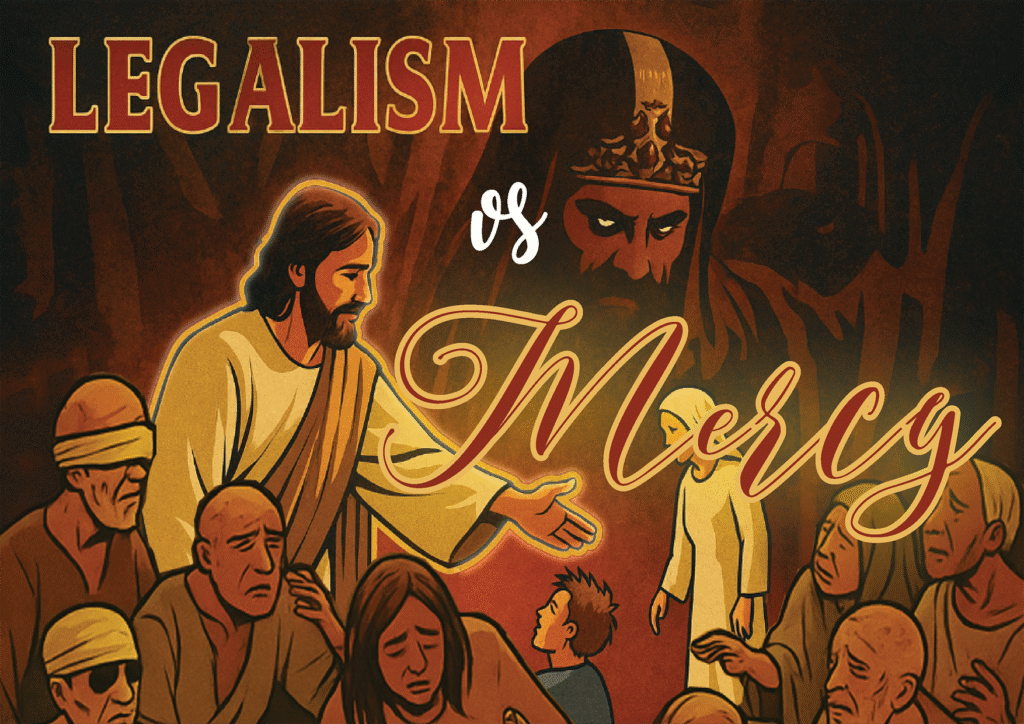
“I Desire Mercy, Not Sacrifice.”
When Jesus said, “It is not the healthy who need a doctor, but the sick. But go and learn what this means: ‘I desire mercy, not sacrifice.’ For I have not come to call the righteous, but sinners” (Matthew 9:13), He was responding to the Pharisees’ criticism of His compassion toward those considered spiritually unworthy. To understand the weight of His words, we must first understand who the Pharisees were in Jesus’ time.
The Pharisees and Their Zeal for the Law
In the first century, the Pharisees were an influential religious movement among the Jews. They were laypeople devoted to the Law of Moses (the Torah) and to a complex system of oral traditions, known as the traditions of the elders. Their goal was to live pure and holy lives, carefully avoiding ritual impurity. They sincerely believed that strict obedience to God’s law would preserve Israel’s holiness.
However, their zeal for external observance led to a rigid legalism that often overshadowed the spirit of the Law. They emphasized ritual purity, minute details, and legal boundaries—what they called the “fences of the Law”—to the point that they became blind to the law’s true purpose: love, mercy, and faithfulness. Jesus exposed this imbalance as hypocrisy—an outward appearance of righteousness that concealed inward corruption. Eventually, their teachings became the foundation of modern Rabbinic Judaism, but during Jesus’ ministry, their legalism repeatedly clashed with His message of grace.
Mercy over Ritual
When Jesus declared, “I desire mercy, not sacrifice,” He quoted Hosea 6:6. His point was not to reject the sacrificial system God had established, but to reveal its deeper meaning: God values compassion and covenantal love more than empty rituals. The Hebrew word for mercy—hesed—also means steadfast love or loving-kindness. It describes the faithful, relational love that God desires from His people, both toward Him and toward one another.
The Pharisees’ obsession with external purity blinded them to the heart of God. Their religion had become rule-centered instead of relationship-centered. In contrast, Jesus’ ministry embodied divine mercy—He welcomed tax collectors, sinners, the sick, and the marginalized. His table fellowship with such people symbolized God’s invitation to the unworthy and the lost.
Jesus’ Mission: To Seek and Save the Lost
When the Pharisees questioned why Jesus dined with sinners, His answer revealed the essence of His mission: “For I came not to call the righteous, but sinners” (Matthew 9:13). Jesus compared Himself to a physician who heals the sick, demonstrating that spiritual restoration—not ritual perfection—was the goal of His coming. He sought those marginalized by its society and alienated from God, not those who trusted in their own righteousness.
This theme is consistent throughout Scripture. In Luke 19:10, Jesus summarized His mission: “For the Son of Man came to seek and to save the lost.” God’s heart has always been relational, not legalistic. “For God so loved the world, that He gave His only begotten Son…” (John 3:16). The Father’s love and mercy define His nature, not rigid enforcement of the law. Even in His pre-incarnate glory, Christ—the very One who gave the Law—chose grace over condemnation.
Jesus and the Pharisees’ Confrontations
Repeatedly, Jesus’ acts of mercy collided with Pharisaic legalism. When He healed the man with the withered hand on the Sabbath (Matthew 12:9–14) and the lame man at Bethesda (John 5:1–18), the Pharisees accused Him of violating Sabbath laws. Jesus exposed their hypocrisy, revealing that they cared more for regulations than for people. He likened them to “whitewashed tombs”—beautiful on the outside, but full of death within (Matthew 23:27).
In defending His actions, Jesus drew upon the story of David and the consecrated bread (1 Samuel 21:1–9). When David and his men were hungry, the priest Ahimelech gave them the holy bread reserved for priests. Though technically unlawful, it was justified by necessity and compassion. Jesus used this example to teach that the law was given to serve life, not to destroy it, and that human need takes precedence over ritual strictness.
Did Jesus Lower God’s Standards?
Absolutely not! When Jesus quoted Hosea 6:6, He certainly did not lower God’s standards. Instead, He restored them to their divine intent. The Law was meant to point toward a heart transformed by love and mercy. The Pharisees clung to the letter of the Law but missed its spirit. Jesus emphasized the inward transformation—what Paul later called the circumcision of the heart (Romans 2:29). True holiness flows from compassion, not compliance; from mercy, not mere observance.
The Heart of the Law
Throughout Scripture, God repeatedly reminds His people that love and mercy fulfill His Law. The prophet Micah declared: “He has shown you, O man, what is good. And what does the Lord require of you? To act justly, to love mercy, and to walk humbly with your God” (Micah 6:8). Jesus’ words in Matthew 9:13 are a continuation of this prophetic tradition—a call back to the heart of true worship.
Rituals, sacrifices, and religious observances were never ends in themselves. They were symbols pointing to a deeper reality: God’s desire for His people to reflect His mercy. Without love and compassion, worship becomes hollow. Jesus, therefore, reminded the Pharisees—and us—that religious observance without mercy is meaningless.
In conclusion, Jesus’ statement, “I desire mercy, not sacrifice,” was both a rebuke and a revelation. It exposed the emptiness of religion without love and revealed the nature of God’s heart—overflowing with grace, forgiveness, and steadfast love. Jesus did not come to abolish the Law but to fulfill it by embodying its truest intent: mercy.
He calls His followers to the same. The true measure of righteousness is not found in rigid adherence to rules, but in a transformed heart that mirrors God’s compassion. For the One who once said, “Blessed are the merciful, for they shall obtain mercy,” is still calling us today—to love as He loves, to forgive as He forgives, and to show mercy, not sacrifice.