
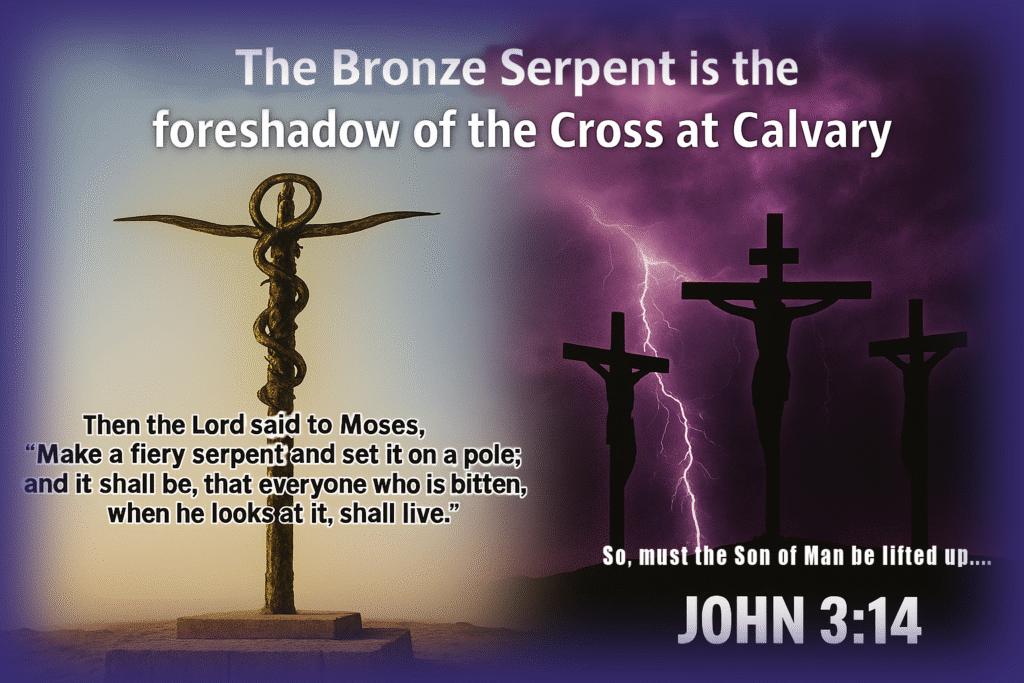
The name Jehovah Rapha, meaning “The Lord Who Heals,” finds one of its most profound expressions in the story of the bronze serpent lifted up by Moses in the wilderness. This remarkable event foreshadows the redemptive work of Christ on Calvary. The primary Bible passages that connect these two events are Numbers 21:8–9 and John 3:14–15. Jesus Himself explicitly makes this connection when He declares that just as the bronze serpent was lifted up in the wilderness to bring healing to the dying Israelites, so must the Son of Man be lifted up on the cross to bring salvation and healing to a dying world corrupted by sin.
In the wilderness, the Israelites rebelled against God and Moses. As a result of their rebellion, God sent poisonous serpents among them, and many were bitten and died. When the people confessed their sin and cried out for mercy, God instructed Moses to make a bronze serpent and set it upon a pole. Whoever looked upon that bronze serpent in faith was healed and lived. Salvation did not come through removing the serpents, but through looking to the divinely provided remedy lifted high before them.
Centuries later, Jesus drew a direct parallel between this event and His own crucifixion when He spoke to Nicodemus in John 3:14–15, saying, “Just as Moses lifted up the serpent in the wilderness, even so must the Son of Man be lifted up, that whoever believes in Him should not perish but have eternal life.” Jesus was pointing forward to His death on the cross. Just as the Israelites had to look to the bronze serpent in faith to receive physical healing, humanity must look to Christ on the cross in faith to receive physical & spiritual healing and eternal life.
The parallel is both vivid and profound. The Israelites were dying because of the venom of the serpents; we are dying because of the poison of sin. Both the bronze serpent and the cross were raised for all to see, and healing was available to everyone who looked in faith. In both cases, deliverance came not by human effort but by trusting in God’s provision. The serpent on the pole represented the very thing that caused death, yet it became the means of healing. Likewise, Jesus “became sin” for us (2 Corinthians 5:21). Though He was sinless, He took the judgment for our sins upon Himself so that we might have life.
The prophet Isaiah beautifully captures this mystery of substitution in Isaiah 53:4–5:
“Surely He took up our pain and bore our suffering,
yet we considered Him punished by God, stricken by Him, and afflicted.
But He was pierced for our transgressions,
He was crushed for our iniquities;
the punishment that brought us peace was upon Him,
and by His wounds we are healed.”
Healing, forgiveness, and life flow from the same source — the loving sacrifice of our Lord and Savior Jesus Christ. It is only by the grace of God and the obedience of His Son that this divine exchange became possible. The stubborn and reckless love of God, combined with the obedient submission of His beloved Son, made our healing and salvation a reality.
The superiority of Christ’s sacrifice over the Old Covenant and the Mosaic Law is repeatedly affirmed in Scripture. While the Law served as a shadow of the good things to come, Christ fulfilled and surpassed it completely. The writer of Hebrews explains this truth in Hebrews 8:6:
“But as it is, Christ has obtained a ministry that is as much more excellent than the old as the covenant He mediates is better, since it is enacted on better promises.”
Paul echoes the same in Colossians 2:14, where he writes:
“Blotting out the handwriting of ordinances that was against us, which was contrary to us, and took it out of the way, nailing it to His cross.”
And again, in Hebrews 10:1, the writer reminds us that,
“The law, having a shadow of the good things to come and not the very image of the things, can never with the same sacrifices year by year make perfect those who draw near.”
The Mosaic Law provided only temporary atonement and an imperfect shadow of what was to come. But Christ’s once-for-all sacrifice brought complete and eternal redemption. His blood did not merely cover sin—it removed it entirely. The bronze serpent healed the Israelites from physical death; the Cross of Christ heals us from both physical and spiritual death. The redemptive power of Christ’s sacrifice secures not only our healing in this life but also our eternal destiny with God, our Abba Father.
Truly, this is the superior redemptive power of Christ’s sacrifice — a power that transcends all former covenants and ordinances. In Christ, we find complete healing, salvation, and everlasting life. Through the Cross, Jehovah Rapha reveals Himself not just as the healer of bodies but as the Healer of souls, the Redeemer of all who believe.
To encapsulate this truth, let us turn to one of the most powerful hymns of faith ever written, a song that beautifully captures the hope, healing, and strength we have in Christ:
In Christ Alone, My Hope Is Found
In Christ alone, my hope is found
He is my light, my strength, my song
This Cornerstone, this solid ground
Firm through the fiercest drought and storm
What heights of love, what depths of peace
When fears are stilled, when strivings cease
My Comforter, my All in All
Here in the love of Christ I stand
In Christ alone, who took on flesh
Fullness of God in helpless babe
This gift of love and righteousness
Scorned by the ones He came to save
‘Til on that cross as Jesus died
The wrath of God was satisfied
For every sin on Him was laid
Here in the death of Christ I live, I live
There in the ground His body lay
Light of the world by darkness slain
Then bursting forth in glorious Day
Up from the grave He rose again
And as He stands in victory
Sin’s curse has lost its grip on me
For I am His and He is mine
Bought with the precious blood of Christ
No guilt in life, no fear in death
This is the power of Christ in me
From life’s first cry to final breath
Jesus commands my destiny
No power of hell, no scheme of man
Can ever pluck me from His hand
Till He returns or calls me home
Here in the power of Christ I’ll stand
As we meditate on these words, may we remember that the same Lord who healed the Israelites in the wilderness still heals today — body, soul, and spirit. Just as they looked to the bronze serpent lifted on a pole, we look to Christ lifted on the Cross, the ultimate expression of God’s healing love.
The bronze serpent was but a shadow of what was to come; the Cross is the substance of that promise fulfilled. Through Jesus Christ, Jehovah Rapha, we are healed, redeemed, and eternally made whole.